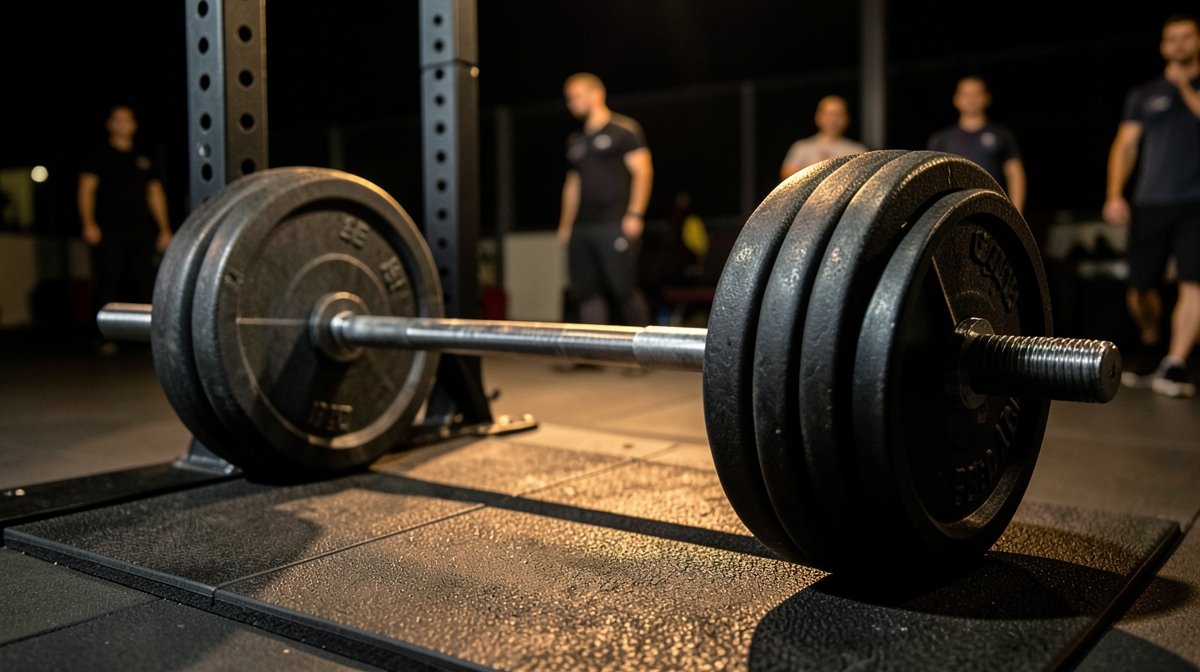
Mechanotransduction converts physical load into chemical signals inside muscle fibers, making mechanical tension the primary driver of muscular hypertrophy. When individual fibers experience high force during active shortening, costamere proteins trigger the mTORC1 pathway to stimulate muscle protein synthesis.
Key Takeaways
- Mechanical tension triggers intracellular signaling cascades via mechanosensitive receptors like focal adhesion kinase.
- High motor unit recruitment requires training within 0 to 4 reps in reserve.
- Full range of motion under active load increases sarcomeres in series through stretch-mediated hypertrophy.
- Weekly volume between 10 and 20 challenging sets per muscle group maximizes tension-mediated growth.
What Is Mechanical Tension and How Does It Drive Hypertrophy?
Mechanical tension occurs when muscle fibers produce active force while resisting external resistance, stretching cellular structures and triggering mechanosensitive pathways. This physical strain deforms cell membranes, opening calcium channels and activating intracellular enzymes that accelerate muscle protein synthesis above baseline rates.
Muscles do not simply sense the total weight on a barbell. They sense the force produced by individual contractile units called actin-myosin cross-bridges. When you lift a load with controlled tempo, tension concentrates across the active fibers, pulling on structural proteins such as titin and dystrophin.
This tensile pull initiates mechanotransduction. Costameric protein complexes convert physical deformation into chemical cascades, specifically upregulating focal adhesion kinase and downstream mTORC1 signaling. Research consistently shows that without adequate mechanical strain on individual muscle fibers, systemic hormone spikes and cellular swelling produce negligible long-term tissue accretion.
- Tension Tracking: Select movements where tension remains continuous on the target muscle throughout the entire path of travel.
How Does Proximity to Failure Maximize Fiber Recruitment?
Training close to muscular failure forces the central nervous system to recruit high-threshold motor units that control the largest, most growth-prone type II muscle fibers. According to Henneman’s size principle, smaller motor units fire first, while larger units activate only as fatigue accumulates or when moving heavy loads.
When you lift a moderate load for 10 reps, the first few repetitions rely primarily on fatigue-resistant type I fibers. As these fibers exhaust their energy reserves, your nervous system recruits high-threshold type II fibers to sustain force output. How do you ensure these high-threshold fibers experience sufficient mechanical strain?
You achieve full recruitment by taking working sets to within 1 to 3 repetitions in reserve (RIR). In our experience with strength athletes, stopping sets 5 or 6 reps short of failure leaves the largest motor units under-stimulated. Studies demonstrate that sets performed at 60% to 85% of one-rep maximum yield equivalent hypertrophy, provided proximity to true momentary failure remains constant.
- Proximity Check: End your primary working sets exactly 1 to 2 reps before your technical form breaks down.
Why Does Stretch-Mediated Hypertrophy Accelerate Growth?
Loaded stretching places individual sarcomeres at long muscle lengths, multiplying passive tension generated by titin alongside active cross-bridge tension. This combined mechanical signal stimulates sarcomerogenesis, adding new sarcomeric units in series and accelerating overall muscle cross-sectional expansion.
When a muscle lengthens under load, the structural protein titin acts like a molecular spring, resisting elongation and adding passive force to the active muscular contraction. This dual-tension state sends a potent anabolic signal to cell nuclei, prompting rapid structural adaptation.
Clinical trials comparing partial range training reveal that training muscles in elongated positions yields up to 40% greater hypertrophy in muscles like the quadriceps and biceps. Performing deep squats, overhead triceps extensions, or full-stretch Romanian deadlifts forces tissue remodeling that short-range pulses simply cannot replicate.
- Length Priority: Pause for one full second in the deepest stretched position of every repetition to eliminate momentum.
What Is the Optimal Rep Range and Volume for Tension?
The optimal hypertrophy range spans 6 to 15 repetitions across 10 to 20 weekly sets per muscle group, balancing heavy fiber recruitment with manageable neurological fatigue. While 3 to 30 reps can build muscle, mid-range sets maximize mechanical load while minimizing joint wear and excessive systemic fatigue.
Very heavy sets below 5 repetitions impose extreme demands on connective tissues and the nervous system, limiting total volume tolerance. Conversely, sets exceeding 20 repetitions produce severe metabolic byproduct accumulation and cardiovascular strain, which can terminate a set before target fibers reach peak mechanical tension.
A meta-analysis on training volume indicates that 10 to 20 hard weekly sets per muscle group provides the ideal stimulus-to-fatigue ratio for most lifters. Distributing this volume across two or three weekly sessions allows you to maintain high force output and barbell velocity on every single working set.
- Volume Structuring: Cap individual muscle group volume at 6 to 8 hard sets per session to maintain peak output.
FAQ
Is mechanical tension more important than metabolic stress?
Yes, mechanical tension is the primary stimulus for muscle growth. Metabolic stress, such as cellular swelling and metabolite accumulation, can amplify the growth response, but it cannot produce significant hypertrophy in the absence of sufficient mechanical tension across working muscle fibers.
How many seconds should each repetition take for optimal tension?
A controlled repetition tempo of 2 to 3 seconds on the eccentric lowering phase combined with an explosive or 1-second concentric lifting phase creates ideal tension. Excessively slow concentric speeds reduce motor unit recruitment by forcing you to use lighter loads.
Can you maximize mechanical tension using light weights?
Yes, you can maximize tension with light weights if you train within 0 to 2 reps of failure. As smaller motor units fatigue during high-rep sets, the nervous system recruits high-threshold motor units to sustain force, exposing them to high mechanical tension.
Does progressive overload directly increase mechanical tension?
Progressive overload ensures mechanical tension stays high over time. As your muscle fibers adapt and grow larger, they require progressively heavier loads or additional repetitions to experience the same relative internal tension and sustain the hypertrophy response.
Structuring your training around peak mechanical tension ensures that every working set delivers a potent hypertrophic stimulus. Prioritize full ranges of motion, precise proximity to failure, and progressive load increments to sustain long-term structural gains across your entire physique.
Subscribe to our newsletter for weekly science-backed protocols.